





WayPorts Environmental management for port authorities
A specialised WayGreen instance, installed on the administration’s own infrastructure: energy, emissions, air, water, waste and biodiversity across every port, in one record.
Vertical solution Status: In production Last verified: 2026-07 Published references: 1
A port answers for its environment.
A port is not a facility: it is a land-and-sea system where energy, fuels, effluents, ship waste, air quality and protected habitats all converge. WayPorts brings those domains together — across every port under the same administration — in a single environmental management system, installed on the organisation’s own infrastructure.
01 The scrutiny
Few infrastructures answer to so many people at once as a port: the environmental regulator, the administration, the municipality, the operators, and everyone living a quay away.
On one side, the European Green Deal and the Fit for 55 standards, which ask for trajectories rather than intentions. On the other, a community — passengers, operators, the municipality — expecting concrete answers about air, water, noise and waste.
And the evidence lives scattered: energy meter readings, water analysis reports, air measurements, waste manifests, spreadsheets kept by different people in different departments.
None of those sources talks to the others. Every report becomes a reconstruction — and a reconstruction cannot be audited, only redone.


02 The turn
WayPorts brings the six environmental domains into one system — and the evidence stops being reconstructed, because it is simply recorded.
Energy, emissions, air, water, waste and biodiversity share one data model, one mesh of operational zones and one history — port by port, and across the administration as a whole.
From there, Green Deal and Fit for 55 reporting, stakeholder information and the administration’s own decisions all come out of the same record, with the origin of every value in plain view.
The platform is installed on the administration’s own infrastructure, and the environmental frameworks that structure each domain were established in partnership with GreenLab — the data model is not a choice we made alone.
The next step, on the Madeira case’s own roadmap, is to instrument more sources: IoT and artificial intelligence over that same record, so decarbonisation is decided on series rather than on estimates.

03 Where it comes from
WayPorts is a specialised instance of WayGreen — the same environmental monitoring and reporting engine, carrying the vocabulary, the zones and the flows of a port authority. The cartographic layers behind those operational zones rest on WayGIS, and when the administration wants to tie the port’s environmental performance to the goals of the territory around it, that is WaySDG. Measuring consumption is a practice, not a talking point: we publish this website’s own footprint too.
04 The scale
Funchal. Caniçal. Porto Santo. One system.
- 3
- ports under one environmental administration Source: ECO PortsMadeira · APRAM
- 6
- environmental domains in the same record Source: ECO PortsMadeira · APRAM
We do not publish consumption, emissions or volumes: those numbers belong to APRAM, and APRAM is who releases them. Here we count only what we built.
05 In the field
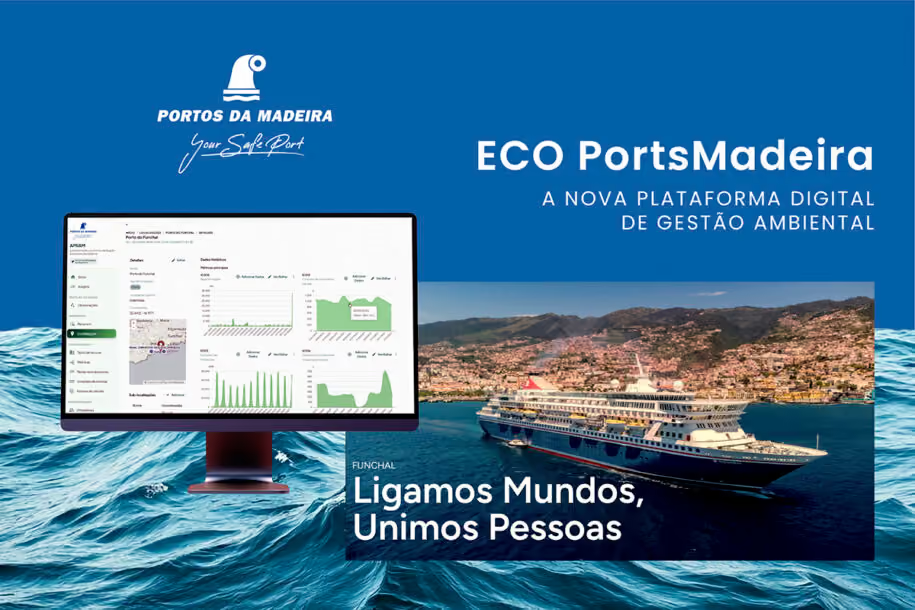
ECO PortsMadeira: the environmental management platform of the Ports of Madeira.
For APRAM — the administration of the ports of the Autonomous Region of Madeira — Waymotion developed ECO PortsMadeira: the platform that consolidates the monitoring of energy, emissions, air, water, waste and biodiversity across the ports of Funchal, Caniçal and Porto Santo into one unified system.
The infrastructure extracts environmental data from disparate sources and manual records, with environmental frameworks established in partnership with GreenLab.
The stated goal goes beyond compliance with the European Green Deal and the Fit for 55 standards: the platform exists to equip port administrators with “a real tool for making strategic decisions based on concrete data”. The roadmap points to the integration of IoT and artificial intelligence as the catalyst of decarbonisation efforts.
Read the full story“Sustainability only achieves real impact when it becomes action.”
 ECO PortsMadeira: APRAM's New Digital Environmental Management Platform
06 Conversation
Let’s talk about your port’s environment.
A technical conversation with the people who build the platform: your administration’s context, which data sources already exist and in what shape, what still has to be instrumented, and the realistic path to a single environmental management system — installed on your own infrastructure.

Next solution
RUB