





RUB Municipal biowaste operations and PAYT tariffs
From the legal mandate to the daily operation: enrolment, validation, kit logistics, the parish-council network and the per-participant record a PAYT tariff requires.
Vertical solution Status: In production Last verified: 2026-07 Published references: 1
Biowaste: from mandate to daily operation.
RUB — Biodegradable Urban Waste — runs the whole programme, not a part of it: resident enrolment online and over the counter, participant validation and progress tracking, distribution of bins and bags, deliveries documented in the field, a dedicated interface for parish councils and partners, direct contact with residents, and environmental monitoring dashboards. That is the record base without which a PAYT tariff is only an intention.

01 The mandate
In 2023, separating biowaste stopped being a recommendation and became a legal duty of every Portuguese municipality.
Meeting that duty is not a matter of buying bins: it means enrolling residents, validating who joins, delivering bins and bags door to door, coordinating parish councils and partners in the field — and proving, with records, that the programme is happening.
Without a dedicated system, that operation lives on paper, in spreadsheets and in inboxes: invisible to the people who manage it, heavy for the people who run it, and hard to report with confidence to the people who audit it.
And without a per-participant record there is no PAYT tariff: a tariff that varies with behaviour has to know, participant by participant, what was delivered, where and when.


02 The turn
RUB puts the whole programme — from the resident’s enrolment to the dashboard of whoever answers for it — into one digital operation, transparent and auditable.
Enrolment, validation, kit logistics, the parish-council network and monitoring stop being parallel processes and become views of the same record, built on WayAdmin, Waymotion’s low-code framework.
Every delivery is documented with geographic accountability — who received what, where and when — which is exactly the footing a PAYT tariff needs in order to be defensible.
On the resident’s side, joining happens online or over the counter and contact is direct, with no administrative detour; on the side of whoever answers for the programme, the dashboards show participation and flows without asking anyone for a spreadsheet.
The next stretch is the one the Mafra case already points to: automating local processes, extending to other waste streams and aligning the programme with sustainability metrics.

03 Where it comes from
RUB rests on WayAdmin, the low-code framework we build municipal operations with. When a municipality wants to tie its biowaste programme to 2030 Agenda indicators and to the budget, that is WaySDG; the territorial reading of routes, parishes and delivery points happens in WayGIS; and the environmental performance of the waste system consolidates in WayGreen. Measuring consumption is a practice, not a talking point: we publish this website’s own footprint too.
04 The scale
From enrolment to dashboard.
- 7
- programme functions integrated in one platform Source: Municipality of Mafra
Participation figures, tonnages and route counts belong to the Municipality of Mafra, and the municipality is who publishes them. Here we count only what the platform integrates — the seven functions listed in the case.
05 In the field
Biowaste in Mafra: a municipal programme with its operation in view.
When the legal separation mandates came into force in 2023, the Municipality of Mafra needed to meet two objectives: fostering public participation and streamlining the logistics of kit distribution.
The RUB platform, built by Waymotion on the low-code WayAdmin framework, took over processing online and in-person registrations, validating participants and tracking their progress, distributing bins and green bags, documenting deliveries with geographic accountability, and giving parish councils and partners an interface of their own — reducing the administrative burden and encouraging civic participation in the circular economy.
Planned developments point to the automation of local processes, expansion to other waste streams and alignment with sustainability metrics — the same path that lets a biowaste programme go on to support a PAYT tariff.
Read the full story“Centralised, transparent and secure digital management.”
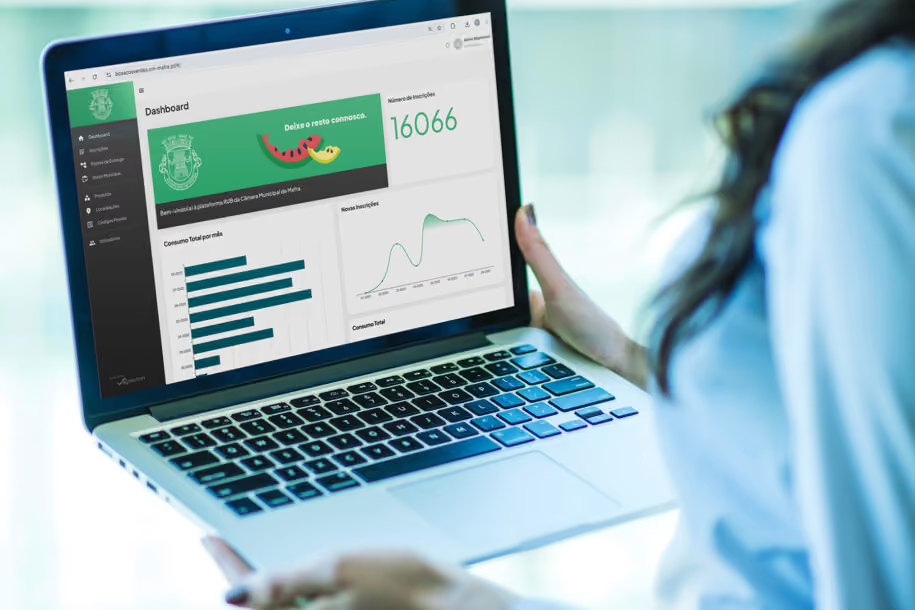
 Technological Innovation in Biowaste Management in Mafra
06 Conversation
Let’s talk about your municipality’s biowaste programme.
A technical conversation with the people who build the platform: the state of your programme, the routes and parishes on the ground, what is already recorded and what still lives on paper — and the path to a digital operation and, when it makes sense, to a PAYT tariff.

Next solution
WayPorts